
Case showcase · DELTA
Case Analysis: Driving a Labelling Machine Feed Axis with the Delta ASDA-B3 Servo Drive
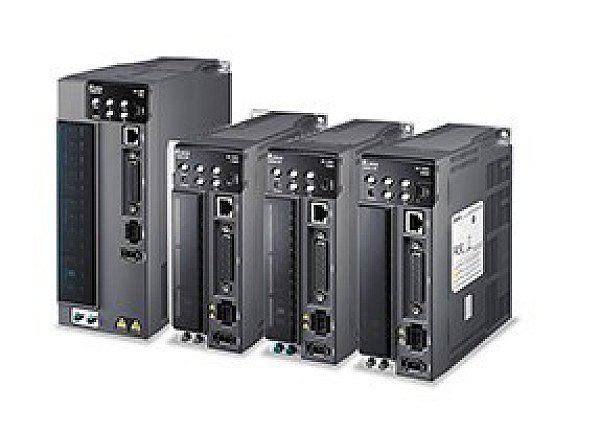
Drive: Delta ASDA-B3 ASD-B3-0421-L (400 W, standard type) + Motor: ECM-B3M-C20604RS1 (400 W, 60 mm medium inertia) · Prepared: 23 November 2026
This is a typical application case, not a named customer project. No customer name, project name, price, stock level or delivery time is stated. Price, stock, compatibility and delivery are confirmed by quotation.
The challenge
A labelling machine feed axis has a simple job and a hard tolerance: advance one label, stop exactly on the gap, and do it again dozens of times a minute. It fails for five reasons: the stop drifts a fraction of a millimetre each cycle until labels land crooked, the constant start-stop overheats a stepper or wears out a small servo, the feed sequence needs a PLC the small machine does not have, the cabinet is too small for a large drive, and the motor is the wrong inertia for the roller and label roll it has to pull.
This case looks at how one 400 W servo set, the Delta ASDA-B3 ASD-B3-0421-L drive with ECM-B3M-C20604RS1 motor, answers those five points, and what a buyer should still check before ordering.
Why this model was chosen
The ASDA-B3 is Delta’s compact servo series, 100 W to 3 kW, and the ASD-B3-0421-L is the 400 W standard type — the size a small labelling or packaging feed axis lands on when the load is a feed roller and a label roll, not a heavy gantry.
Three features decide it for this application, and they are the ones a stepper or a basic servo usually lacks:
- 24-bit encoder with 3.1 kHz response bandwidth — 16,777,216 pulses per revolution, so the stop position is fine enough for the label gap, and the drive follows the start-stop command without lag.
- Built-in PR mode, 100 motion paths — the feed-index cycle lives in the drive itself, so the small machine does not need a separate PLC just to run the feed sequence.
- Compact and light — the drive is 60 mm wide and 0.9 kg, the motor 1.2 kg, so the set fits a small cabinet and a light feed mechanism.
If the axis is vertical and needs a holding brake, the same 400 W motor is available with a brake (ECM-B3M-C20604SS1). If the machine needs safety torque-off, the B3 series does not have STO — that is the B3A series. The set in this case is the standard no-brake horizontal feed axis.
Key specifications (verified)
All figures are from Delta’s official ASDA-B3 User Manual (DELTA_IA-ASD_ASDA-B3_UM_EN_20250108) and the ASDA-B3 series catalog (DELTA_IA-ASD_ASDA-B3_C_EN_20240703).
| Specification | ASD-B3-0421-L (drive) |
|---|---|
| Series / type | Delta ASDA-B3, standard type -L |
| Applicable motor | 400 W |
| Input power | Single / three-phase 200 – 230 VAC, −15% to +10% |
| Input current | Single-phase 3.74 Arms / three-phase 2.04 Arms |
| Rated output current | 2.65 Arms (continuous) |
| Maximum output current | 10.6 Arms |
| Encoder | 24-bit (16,777,216 p/rev), with absolute value function |
| Speed control range | 1:6000 |
| Response bandwidth | Up to 3.1 kHz |
| PR mode | Built-in, 100 motion paths (PR#0 – PR#99) |
| Pulse input | Pulse + direction, max 4 Mpps; open collector 200 Kpps |
| Digital I/O | 9 inputs / 6 outputs |
| Communication | RS-485 Modbus (CN3) + Mini USB (CN4) |
| Built-in brake resistor | 100 Ω / 40 W |
| Working temperature | 0 to +55 °C (forced cooling above +45 °C) |
| Protection | IP20 (inside cabinet) |
| Cooling | Natural air cooling |
| Dimensions / weight | 60 × 162 × 70 mm, 0.9 kg |
| Breaker / contactor / fuse | 10 A / 10 A / 10 A (T class) |
| Specification | ECM-B3M-C20604RS1 (motor) |
| Inertia / flange | Medium inertia, 60 mm |
| Rated power | 400 W |
| Rated / maximum speed | 3000 / 6000 rpm |
| Rated / maximum torque | 1.27 / 4.45 N·m |
| Rated current | 2.40 Arms |
| Rotor inertia | 0.254 × 10⁻⁴ kg·m² |
| Weight | 1.2 kg (without brake) |
| Shaft / oil seal | Keyway shaft, without brake, with oil seal |
How the specifications answer the five problems
Stop accuracy — 24-bit encoder, 4 Mpps pulse input, 3.1 kHz bandwidth
The label gap is found by a sensor, but the stop itself is the servo’s job: the 24-bit encoder resolves 16,777,216 pulses per revolution, the drive accepts pulse commands up to 4 Mpps, and the 3.1 kHz response bandwidth means the drive follows the stop command instead of overshooting it. The result is the same stop position cycle after cycle, so labels do not drift across the roll.
Frequent start-stop — fast response plus a built-in brake resistor
A feed axis starts and stops dozens of times a minute, and every stop sends energy back into the drive. The 3.1 kHz bandwidth keeps up with the cycle rate, and the built-in 100 Ω / 40 W regenerative resistor absorbs the braking energy first. If the cycle is faster or the roll heavier than planned, check the regenerative load against the manual — an external resistor can be added, but the built-in one covers the normal labelling duty.
No PLC for the feed sequence — PR mode with 100 paths, 9 inputs / 6 outputs
The feed-index cycle — advance, wait for the gap sensor, stop, signal the print or apply head — can be stored as motion paths in the drive itself: 100 PR paths (PR#0 – PR#99), triggered by the 9 digital inputs, with 6 digital outputs driving the photoelectric sensor input and the air valve. A small labelling machine does not need a separate PLC just to run the feed sequence. RS-485 Modbus (CN3) is there if a host controller is added later.
Small cabinet — 60 mm wide drive, 0.9 kg
The drive is 60 mm wide and 0.9 kg, the motor 1.2 kg, so the set fits a small cabinet and a light feed mechanism without a large drive enclosure. It is IP20, so it mounts inside the cabinet — not on the machine frame in the open. Above +45 °C the cabinet needs forced cooling.
Matching the mechanics — medium inertia, 1.27 N·m rated torque
A feed roller with a label roll behind it is a changing inertia: the roll gets lighter as labels are used. The medium-inertia 60 mm motor is tolerant of that change, so the start-stop does not shake as the roll empties. Rated torque 1.27 N·m at 3000 rpm pulls the roller; the 4.45 N·m maximum covers the acceleration peak. If the roller is much heavier, or the axis is vertical, check the inertia ratio and the brake version before ordering.
Application and installation notes
- Motor pairing. The 400 W drive pairs with the ECM-B3M-C20604RS1 (medium inertia, 60 mm). There is no low-inertia 400 W motor in the ECM-B3 range — the low-inertia line stops at 100 W. For high inertia, the ECM-B3H-C20604RS1 is the alternative (up to 6700 rpm, 4.83 N·m maximum torque).
- Brake or no brake. The RS1 motor in this case has no brake. A vertical axis (Z axis) that must hold position on power loss needs the S version, ECM-B3M-C20604SS1.
- No STO on the B3. The B3 series has no safe torque-off. If the machine needs STO, choose the B3A series instead.
- Power and protection. Single-phase or three-phase 200 – 230 VAC both work; size the breaker, contactor and fuse at 10 A each. Above +45 °C inside the cabinet, forced cooling is required, and IP20 means inside the cabinet only.
- Replacing an older servo. Before swapping an old drive and motor for this set, check the pulse interface, the communication port and the motor flange — send us the old drive and motor models or photos of their nameplates and we will check them against the manual.
- Model code. The last letter matters: -L is the standard type (pulse + RS-485); -M is CANopen; -F is DMCNET; -E is EtherCAT. The old “-B” code no longer exists — do not order by it.
What to check before ordering
- Load and mechanics — feed roller diameter and weight, label roll weight, and whether the axis is horizontal or vertical.
- Cycle rate — labels per minute, and the stop accuracy the gap sensor needs.
- Control — pulse command from a controller, or the feed sequence stored in the drive’s PR mode; whether Modbus monitoring is needed.
- Cabinet conditions — worst-case temperature inside the enclosure, available width (60 mm per drive), and whether forced cooling is needed above +45 °C.
- Quantity and destination country — for the quotation, export shipping and the correct certification marks for your market.
If any of these is unknown, send the old drive and motor models or photos of their nameplates and we will check them against the manual.
Request a quotation
Guangzhou Hongwei Electromechanical Technology Co., Ltd. (广州弘纬机电科技有限公司) supplies Delta servo drives and motors — ASDA-B3 and the wider ASDA range — for machine builders and industrial users, for export worldwide.
Website: https://mwsell.shop/ · WhatsApp: https://wa.me/84346271021 (+84 346 271 021) · Email: changtaowu6@gmail.com
Send the model numbers (ASD-B3-0421-L drive + ECM-B3M-C20604RS1 motor — or the brake version ECM-B3M-C20604SS1 for a vertical axis), the quantity, and your destination country. Price, stock, compatibility and delivery are confirmed by quotation.
Sources
Delta official ASDA-B3 User Manual (DELTA_IA-ASD_ASDA-B3_UM_EN_20250108): model codes, pairing table §1.3.1, PR mode Chapter 7 (100 paths), regenerative resistor §2.8, drive specifications Appendix A.1, motor specifications Appendix A.2. Delta official ASDA-B3 series catalog (DELTA_IA-ASD_ASDA-B3_C_EN_20240703): 3.1 kHz bandwidth, product photos. No price, stock, lead-time or delivery claims — those are confirmed by quotation.